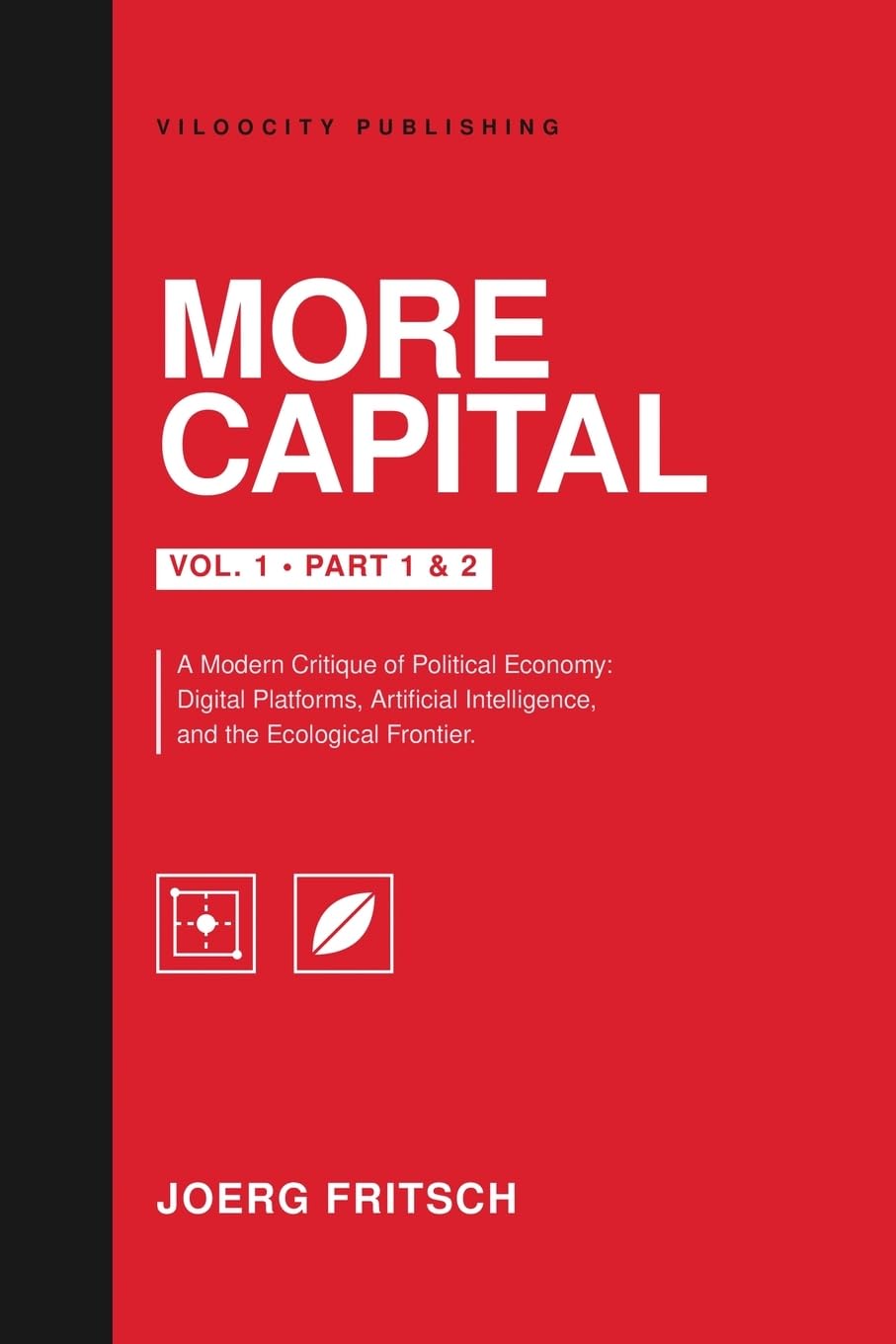
Vol. 1 · Part 1 & 2

MORE
CAPITAL

A Modern Critique of Political Economy

Digital Platforms, Artificial Intelligence, and the Ecological Frontier — an epistemological rupture for the age of platform capitalism.

Updates Marx's Capital
Triune Value Theory
Ecological Frontier
More Capital Book Cover
Scroll
SNLT SNRT Impact Multiplier Harmonized Human Time Platform Capitalism Epistemological Rupture Organic Intellectuals Counter-Hegemonic Practice Algorithmic Governance Cyborg Apparatus Value Singularities Attention Economy SNLT SNRT Impact Multiplier Harmonized Human Time Platform Capitalism Epistemological Rupture Organic Intellectuals Counter-Hegemonic Practice Algorithmic Governance Cyborg Apparatus Value Singularities Attention Economy
The Framework

Transdisciplinarity as
Epistemological Rupture

Contemporary societal challenges — ecological breakdown, digital surveillance, and algorithmic governance — demand analytical frameworks that transgress disciplinary boundaries. Classical political economy, while foundational, cannot alone account for the value dynamics of platform capitalism.

Political Economy

The political economy of production reveals how labour is extracted, commodified, and alienated under platform capitalism. Yet alone, it cannot see beyond the factory floor.

Media & Attention

Media studies exposes the attention economy — how platforms mine, capture, and monetize human cognition. But without political economy, it cannot trace value to its source.

Ecological Ethics

Ecological realities reveal the material costs hidden behind "weightless" digital commodities. Server farms, e-waste, and resource extraction demand their own accounting.

Capital fragments our understanding — separating the economics of labour from the ecology of extraction and the sociology of digital attention — to prevent a holistic critique of value. A deeper, critical transdisciplinarity requires epistemological rupture: the dismantling of the disciplinary boundaries that capitalism relies upon to obscure its totalizing effects.

Use-Value & Exchange-Value

The Illusion of
"Air"

Under modern capitalism, use-values increasingly seem dematerialized — digital services, personal data, viral content — yet they remain anchored in vast material infrastructures. The illusion of dematerialization masks the human labour and ecological costs embedded in every "weightless" commodity.

Exchange-value appears as a fluctuating ratio, driven by virality and attention. This suggests that the common substance of value must be broader than production labour alone.

Digital Services e.g. Netflix
Illusion Untethered from materiality
Hidden Basis Server farms (5.3% global electricity), device manufacturing
Personal Data Predictive
Illusion Abstract "predictive tool"
Hidden Basis Data centres ($316B market), surveillance tech, content moderation labour
Viral Content e.g. TikTok
Illusion "Spontaneous" virality
Hidden Basis Algorithmic labour, attention-mining infrastructure
The Triune Character

Three Dimensions of
Human Time

Classical political economy split labour into concrete and abstract. The digital economy forces a tripartite expansion: every commodity embodies three qualitatively distinct temporal expenditures, unified as harmonized human time.

Bodily Analogue: Muscles

SNLT

Socially Necessary Labour Time

The labour time required to produce a commodity under average conditions. Automation and digital tools relentlessly reduce SNLT.

Production Time
Key Innovation
Bodily Analogue: Nerves

SNRT

Socially Necessary Realization Time

The average duration of user attention that society must invest for the commodity to fulfill its function. Attention as a form of socially necessary labour.

Realization Time
Bodily Analogue: Brain

ei

Impact Multiplier

Reorganizing cooperation networks; ethical-ecological imagination. Systemic externalities — ecological damage or network effects — modulate value exponentially.

Amplified Time
Formalization

The Value
Equation

V = κ · Vbase · ei

Where V is the total value of a commodity — the crystallization of harmonized human time.

Base Value
Vbase = 2 · NLT · ŜNRT / NLT + ŜNRT

The harmonic mean of normalized production time and realization time. If either time collapses, value collapses — both production AND realization are necessary.

Impact Coefficient
i = w1seco + w2slab + w3ssys + w4sinst

Aggregates weighted scores across ecology, labour & ethics, systemic effects, and institutional domains — each normalized between −1 and +1.

Impact Coefficient Domains
Ecology w = 0.35
Life-cycle emissions, waste, resource use
Labour & Ethics w = 0.30
Wages, safety, algorithmic fairness, supply chain ethics
Systemic Effects w = 0.25
Knowledge sharing, network resilience, market concentration
Institutional w = 0.10
Tax compliance, legal obedience, support for public goods
Digital Commodities

Value
Singularities

Digital goods exhibit non-classical properties: near-zero marginal reproduction costs and network-driven value accretion. This leads to value singularities — a plateau where total value stops growing despite infinite replication.

limn→∞ Vtot(n) = 2κL₀ei

Total value plateaus at a finite ceiling. Cultural phenomena spread globally while their direct monetary value stabilizes. The surplus is captured by platforms that control the attention infrastructure.

This insight provides a critical basis for challenging intellectual property regimes and advocating for alternative models like universal basic attention dividends.

Total Value vs. Copies (n)
2κL₀ei
n → ∞
0
Vtot
Critique

Commodity Fetishism &
The Cyborg Apparatus

In the attention economy, commodity fetishism intensifies. The platform appears as a neutral intermediary, but it is the site where users' SNRT and creators' SNLT are captured and monetized.

Platform as Intermediary

The platform appears as a neutral intermediary, but it is the site where users' SNRT and creators' SNLT are captured and monetized. Commodity fetishism intensifies as the social relations behind digital commodities become entirely opaque.

AI as Hegemonic Infrastructure

Artificial intelligence systems embed hegemonic values into technical infrastructure. Training data crystallizes a specific worldview as "common sense," while task optimization encodes capitalist rationality as natural and universal.

The value equation V = κVbaseei must be read politically, as the site of struggle over what times count, whose impact is registered, and what is rendered invisible. This critical dimension ensures that knowledge synthesis does not merely optimize the current system, but challenges its underlying hegemonic assumptions.

Transdisciplinary Praxis

Organic Intellectuals &
The War of Position

Transdisciplinarity requires more than academic synthesis; it requires a "war of position" to alter the benchmarks of value in civil society. This framework serves as a critical boundary object for that struggle.

Contesting the Algorithmic Equivalent

By formalizing SNRT and ei, worker cooperatives can mathematically demonstrate how platforms compress realization time (attention scalping) to extract surplus — providing empirical leverage for labour disputes.

Democratizing Impact Calibration

The impact coefficient i exposes ecological and social externalities hidden by corporate greenwashing. Environmental movements can demand that negative externalities be formally registered as negative impact multipliers.

Designing Post-Capitalist Metrics

The triune framework offers a blueprint for impact-adjusted taxation and attention dividends, shifting metrics from GDP to the equitable distribution of harmonized human time.

"Transformative change cannot occur without a revolutionary theory — a cognitive map that reveals the totality of the system."

— More Capital
The Author

Joerg Fritsch

JF

Joerg Fritsch is an independent researcher working at the intersection of Marxian political economy, critical media studies, and ecological ethics. His work seeks to develop the conceptual infrastructure necessary for transdisciplinary critique of platform capitalism.

More Capital represents the culmination of this project: a systematic updating of Marx's Capital for the digital epoch, introducing the triune value theory — integrating socially necessary labour time, socially necessary realization time, and the impact multiplier — as a unified framework for understanding value in the age of digital platforms, artificial intelligence, and ecological crisis.

Published by Viloocity Publishing.

Viloocity Publishing

MORE CAPITAL

Vol. 1 · Part 1 & 2

A Modern Critique of Political Economy: Digital Platforms, Artificial Intelligence, and the Ecological Frontier

Worldwide Shipping
eBook Available
Secure Payment
Key References
[1] Smythe, D.W. (1977) "Communication: Blindspot of Western Marxism", Canadian Journal of Political and Social Theory, 1(3): 1–27.
[2] Terranova, T. (2000) "Free Labor: Producing Culture for the Digital Economy", Social Text, 18(2): 33–58.
[3] Marx, K. (1867) Capital, Vol. I. Various editions.
[4] Srnicek, N. (2017) Platform Capitalism. Cambridge: Polity.
[5] Gramsci, A. (1971) Selections from the Prison Notebooks. London: Lawrence & Wishart.
[6] Haraway, D. (1991) "A Cyborg Manifesto", in Simians, Cyborgs, and Women. New York: Routledge.
[7] Moore, J.W. (2015) Capitalism in the Web of Life. London: Verso.
[8] Mager, A. (2012) "Algorithmic Ideology", Information, Communication & Society, 15(5): 769–787.
[9] Marcuse, H. (1964) One-Dimensional Man. Boston: Beacon Press.
[10] Zuboff, S. (2019) The Age of Surveillance Capitalism. New York: PublicAffairs.